“I hate the way they portray us in the media. If you see a black family, it says they're looting. See a white family, it says their looking for food. They've given them permission to go down there and shoot us. George Bush doesn't care about black people.”
-Rapper Kanye West
“These Troops know how to shoot and kill and
they are more than willing to do so, and I expect they will.”
-Louisiana Gov. Kathleen Blanco on the national guard troops who
arrived in New Orleans from Iraq to fight “looting”.
The corporate media is up in arms. Possibly thousands dead, a city under water, and yet when people take food they need to survive from corporate stores that have been abandoned, then it becomes a disaster and it's looting and anarchy according to to people like Bill O'Reilly.
Well first of all, I don't think any true anarchist would call the situation in the areas ravaged by hurricane Katrina anarchy. Chaos perhaps, but not anarchy. While, like most philosophies, there are many different branches of anarchism, the basic idea is that people are inherently good, and can create a society based on radically direct democracy in all spheres of life- political, economic, personal, social, etc. This would mean the eradication of government, bosses and capitalism, patriarchy, racism, and a host of other oppressive hierarchical systems.
So looting is not quite anarchy. Although some anarchists like Peter Kropotkin have proposed the eradication of the wage slavery system and currency to be replaced with en economic system of gift-giving based on mutual aid, the looting in the Gulf region is only people taking for free. There needs to be the other side of democratically organized work places offering their services and products for free for it to be called true anarchism.
Despite this, the looting in the hurricane zones is understandable and justified. Those who could not afford to leave their homes before the hurricane hit were mostly African-American. While Hurricanes don't judge people, the political and economic system in the US certainly does. This system decided long ago to judge Africans as inferior, and to do what it cold to make sure they never rose to the top. This is why so many Africans were hit the worst by the hurricane and flooding.
For to long the system in this country has kept many African-Americans in the south in poverty and given them barely enough to survive. Looting was already justified before the hurricane. Now people's homes, life savings, and personal belongings are forever gone. Now that people are starving and in need of clothing, now that people need televisions to watch the news and decide what to do, looting is especially justified as an act of survival.
There have also been reports of prison riots in the hurricane zone. While it has been hard to validate this, one must also keep in mind the extreme racism in the prison industrial complex. Professor and activist Angela Davis has written extensively on the topic of how the US targets poor communities of color with ridiculous schemes like the “war on drugs” in order to fill prisons with cheap slave labor for major multinational corporations. Even though there might be some legitimately dangerous people in prison, there are far more dangerous people running the prisons. If politically conscience, prison revolts can play a role in creating a society that is truly liberated. Consider the prison uprisings in the 1960's inspired by the actions of Black Panther George Jackson.
Some have started criticizing the US government for spending to much time and money on the war in Iraq and elsewhere than preparing for a major natural disaster like Hurricane Katrina. Certainly Katrina has caused more property damage and possibly more deaths than 9/11.
While these criticisms have a point, certainly a sane society would spend it's resource on helping each other instead of bombing others, it's hard to believe that the US has good intentions in New Orleans. Sure there have been some dramatic helicopter rescues, but remember, marshal law has been declared. Police and the national guard have the law on their side if they shoot someone and claim that they were looting, who's going to question them? Don't forget it was the national guard called up to quell rebellions in the 1960's and sent off to kill Iraqi's today. As recent as late July of this year, New Orleans police murdered Raymond Robair a 48 year old black man, for the crime of sitting out on his porch at night. They also recently killed black youth Jenard Thomas and two officers were being charged with rape. But like the New York Police Department after 9/11, the media conveniently forgot how it was the NYPD that shot Amadou Diallo 41 times for reaching for his wallet.
One of the most frustrating things about this situation, is that the police and national guard, are all we have to rely on. The Left in the US has yet to create an independent force capable of dealing with mass social and civil emergencies. Sure, some charitable people will give to the Red Cross and Salvation Army to help provide food, medicine and clothing for the victims of Katrina. But it should be kept in mind how both the Red Cross and Salvation Army maintain anti-gay discriminatory policies. The Salvation Army's national office shot down the Salvation Army's West Coast's attempts to provide same-sex partner benefits. The Red Cross is a big supporter of the Food and Drug Administrations ban on accepting blood donations from people who have engaged in homosexual sex acts. If you donate money to one of these organizations, please at least write them a letter expressing your outrage at their homophobia.
The thought that is worrying many people though, is the idea that this hurricane wasn't completely an act of nature, but a possible effect of human induced global warming. Consider the gigantic earthquake that led to the Tsunami earlier this year. What's up with this drought in the mid-west, that statistically rivals that of the dust bowl? Yet there is a myth being spread by right wingers. A myth possibly as dangerous as holocaust denial- global warming denial. Oil tycoons, politicians and pundits are lining up to say that somehow they know better than the majority of scientists in the world.
You would think these kind of natural disasters, plus the fact that we are sacrificing our friends and family for oil in Iraq and Afghanistan, and the high price of gas would convince us to change our ways. What does Bush do though? He uses the disaster in New Orleans to relax Environmental Protection Agency guidelines so that gas companies can produce gas quicker, cheaper, but also dirtier.
If we are to challenge all of this we must start asking ourselves tough and forward thinking questions. Can looting in New Orleans be taken to the next level and lead to expropriation of the means of production? Many factories and places of business must be abandoned and with authorities overwhelmed elsewhere, a cooperative of workers could seize their former workplaces and operate them without bosses. A similar movement is on the rise in Argentina as documented in the movie “The Take”.
How can we resist martial law and racism in the hurricane zones? How can we stop global warming? How can we prevent the US from reinstating the capitalist status quo in the flooded areas? We want New Orleans to be rebuilt with great Jazz and cultural centers, not with Starbucks, Wal-Mart and Haliburton. Here's one audacious idea: radicals can flood the city of New Orleans and rebuild it ourselves.
For updates and more on how your can help visit www.neworleans.indymedia.org and Katrina.indymedia.org. For the Chicago response visit www.chicago.indymedia.org
Fundraiser for a destroyed Anarchist New Orleans Housing Cooperative: Saturday October 15th, 6-10 pm, 1766 W. Morris. Vegan Cajun food.
To Support Grassroots, Non-corporate and
Non-Government Relief Efforts go to
http://katrina.mayfirst.org/

Sunday, October 16, 2005
Thursday, September 15, 2005
The Truth Hurts
The following was a letter to the Editor that the Chicago Reader Published in September 2005.
_____________________________________________________________________
As a student at DePaul I took a class with Professor Norman Finkelstein ["Whose Holocaust Is It Anyway?" August 26]. Finkelstein was a professional who took his work and teaching as seriously as his dedication to justice.
To illustrate a point in class he once talked about a movie where a lawyer must defend her father in court against allegations that he was a Nazi war criminal. As the movie went on, she became the only person who stumbled across evidence that her father was indeed a war criminal who helped commit mass murder. She is faced with the moral dilemma: does she turn her father in to face justice, or does she defend him and hide the evidence because he is family?
In many ways, I think this illustrates Finkelstein's devotion to justice. While Alan Dershowitz supports Israel's use of torture and occupation because they are Jews like himself, Finkelstein has the courage to say that justice is for all people, no matter their nationality, religion, or relationship to family.
Matt Muchowski
Lincoln Park


Monday, February 21, 2005
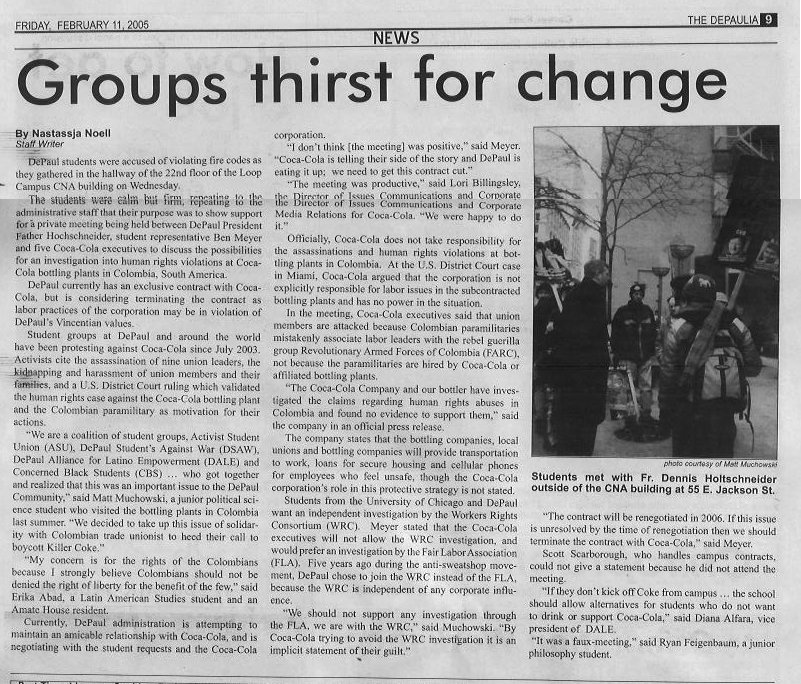
Groups Thirst for Change by Nastassja Noell
This article by Nastassja Noell quotes me talking about the protest I was a part of at DePaul against Coca-Cola.
The link to the article on the DePaulia's website is available here.
____________________________________________________________________________________________________
Groups thirst for change
by Nastassja Noell
Staff Writer

The link to the article on the DePaulia's website is available here.
____________________________________________________________________________________________________
Groups thirst for change
by Nastassja Noell
Staff Writer
DePaul students were accused of violating fire codes as they gathered in the hallway of the 22nd floor of the Loop Campus CNA building on Wednesday.
The students were calm but firm, repeating to the administrative staff that their purpose was to show support for a private meeting being held between DePaul President Father Hochschneider, student representative Ben Meyer and five Coca-Cola executives to discuss the possibilities for an investigation into human rights violations at Coca-Cola bottling plants in Colombia, South America.
DePaul currently has an exclusive contract with Coca-Cola, but is considering terminating the contract as labor practices of the corporation may be in violation of DePaul’s Vincentian values.
Student groups at DePaul and around the world have been protesting against Coca-Cola since July 2003. Activists cite the assassination of nine union leaders, the kidnapping and harassment of union members and their families, and a U.S. District Court ruling which validated the human rights case against the Coca-Cola bottling plant and the Colombian paramilitary as motivation for their actions.
“We are a coalition of student groups, Activist Student Union (ASU), DePaul Student’s Against War (DSAW), DePaul Alliance for Latino Empowerment (DALE) and Concerned Black Students (CBS) … who got together and realized that this was an important issue to the DePaul Community,” said Matt Muchowski, a junior political science student who visited the bottling plants in Colombia last summer. “We decided to take up this issue of solidarity with Colombian trade unionist to heed their call to boycott Killer Coke.”
“My concern is for the rights of the Colombians because I strongly believe Colombians should not be denied the right of liberty for the benefit of the few,” said Erika Abad, a Latin American Studies student and an Amate House resident.
Currently, DePaul administration is attempting to maintain an amicable relationship with Coca-Cola, and is negotiating with the student requests and the Coca-Cola corporation.
“I don’t think [the meeting] was positive,” said Meyer. “Coca-Cola is telling their side of the story and DePaul is eating it up; we need to get this contract cut.”
“The meeting was productive,” said Lori Billingsley, the Director of Issues Communications and Corporate Media Relations for Coca-Cola. “We were happy to do it.”
Officially, Coca-Cola does not take responsibility for the assassinations and human rights violations at bottling plants in Colombia. At the U.S. District Court case in Miami, Coca-Cola argued that the corporation is not explicitly responsible for labor issues in the subcontracted bottling plants and has no power in the situation.
In the meeting, Coca-Cola executives said that union members are attacked because Colombian paramilitaries mistakenly associate labor leaders with the rebel guerilla group Revolutionary Armed Forces of Colombia (FARC), not because the paramilitaries are hired by Coca-Cola or affiliated bottling plants.
“The Coca-Cola Company and our bottler have investigated the claims regarding human rights abuses in Colombia and found no evidence to support them,” said the company in an official press release.
The company states that the bottling companies, local unions and bottling companies will provide transportation to work, loans for secure housing and cellular phones for employees who feel unsafe, though the Coca-Cola corporation’s role in this protective strategy is not stated.
Students from the University of Chicago and DePaul want an independent investigation by the Workers Rights Consortium (WRC). Meyer stated that the Coca-Cola executives will not allow the WRC investigation, and would prefer an investigation by the Fair Labor Association (FLA). Five years ago during the anti-sweatshop movement, DePaul chose to join the WRC instead of the FLA, because the WRC is independent of any corporate influence.
“We should not support any investigation through the FLA, we are with the WRC,” said Muchowski. “By Coca-Cola trying to avoid the WRC investigation it is an implicit statement of their guilt.”
“The contract will be renegotiated in 2006. If this issue is unresolved by the time of renegotiation then we should terminate the contract with Coca-Cola,” said Meyer.
Scott Scarborough, who handles campus contracts, could not give a statement because he did not attend the meeting.
“If they don’t kick off Coke from campus … the school should allow alternatives for students who do not want to drink or support Coca-Cola,” said Diana Alfara, vice president of DALE.
“It was a faux-meeting,” said Ryan Feigenbaum, a junior philosophy student.
Sunday, November 7, 2004
Student Leads Lonely Write in Effort
The following image is a copy of the Chicago Tribune article that quoted me on the 2004 election.
A few notes on this blurb:
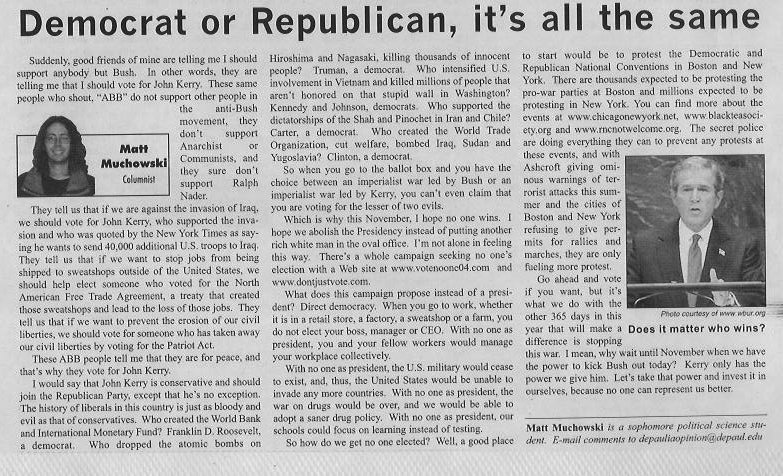
I knew that John Kerry was going to win Illinois by a good margin. While I respected his work in Veitnam Veterans Against the War, since he became a Senator, I felt he moved to the right, and his vote for the Iraq war was a direct stand against his previous peace activism. I knew that people were going to be asking me who I voted for, so I decided to use the opportunity to educate people. I wrote in Leonard Peltier's name for President, because I wanted to educate people about who he was and how unjust his imprisonment is. I did an absentee ballot a month before the election, and had several people ask me who I was voting for before the election, and I told them all about Pelteir, and how he was a Native American of Oglala Souix background who is a political prisoner in the US because of his involvement in the American Indian Movement, a 1960's era group like the Black Panthers.
The day after the election, I was with DePaul Students Against the War in the DePaul student center, handing out fliers, trying to get people to come out the anti-war rally that night. There was going to be a rally no matter who won, but the Bush victory brought out more people. That's when the reporter from the Tribune came up to me and asked me a few questions. The full quote by the way is "No matter who won, U.S. troops are still going to be killing people in Fallujah." Also the black t-shirt I was wearing was a gift from my mom that reads "I hate the government."
I eventually sent a copy of the article to Leonard Peltier. I think my goal of educating some people about his imprisonment was realized.
_______________________________________________________________________________________________

A few notes on this blurb:
I knew that John Kerry was going to win Illinois by a good margin. While I respected his work in Veitnam Veterans Against the War, since he became a Senator, I felt he moved to the right, and his vote for the Iraq war was a direct stand against his previous peace activism. I knew that people were going to be asking me who I voted for, so I decided to use the opportunity to educate people. I wrote in Leonard Peltier's name for President, because I wanted to educate people about who he was and how unjust his imprisonment is. I did an absentee ballot a month before the election, and had several people ask me who I was voting for before the election, and I told them all about Pelteir, and how he was a Native American of Oglala Souix background who is a political prisoner in the US because of his involvement in the American Indian Movement, a 1960's era group like the Black Panthers.
The day after the election, I was with DePaul Students Against the War in the DePaul student center, handing out fliers, trying to get people to come out the anti-war rally that night. There was going to be a rally no matter who won, but the Bush victory brought out more people. That's when the reporter from the Tribune came up to me and asked me a few questions. The full quote by the way is "No matter who won, U.S. troops are still going to be killing people in Fallujah." Also the black t-shirt I was wearing was a gift from my mom that reads "I hate the government."
I eventually sent a copy of the article to Leonard Peltier. I think my goal of educating some people about his imprisonment was realized.
_______________________________________________________________________________________________

Monday, August 9, 2004
Solidarity Activists Stand with Colombia by Meredith Aby
This article quotes me on the delegation I was a part of to Colombia in the summer of 2004. Written by Meredith Aby, and originally printed in Fight Back! the official newspaper of Freedom Road Socialist Organization. You can read the post on the Fight Back! website here.
_______________________________________________________________________________________________
_______________________________________________________________________________________________
For two weeks in July, a solidarity delegation of the Colombia Action Network (CAN) traveled in Colombia, meeting with leading trade unionists, peasant leaders and other participants in that country’s powerful movement for justice and liberation. The CAN delegation was made up of anti-war and student activists from Illinois, Minnesota and Connecticut. The delegation investigated the impact of U.S. military aid through Plan Colombia and extended solidarity to the struggle of the Colombian people against U.S. imperialism.
 | |
Colombia Action Network solidarity with trade unionists in Barrancabermeja. . |
The U.S. has sent the Colombian government nearly $3 billion in military aid, which funds both the military and paramilitary war on trade unionists, human rights workers, student leaders and campesinos (peasants). This aid includes military advisors, weapons, helicopters and fumigation chemicals.
The CAN delegation met with representatives from the unions leading the labor movement in Colombia, including the CUT, Colombia's largest labor federation; USO, the oil workers’ union; the Bogotá teachers' union and SINALTRAINAL, the beverage workers’ union which has been fighting at Coca-Cola plants.
Colombia is the most dangerous place in the world to be a trade unionist. On average, right-wing paramilitary death squads and the military murder three Colombian trade unionists per week. Many more are threatened every day. During the trip, two of the unions the delegation met with had members murdered that very day.
Despite the danger, unions are fighting back and defending their right to organize. In May, the oil workers union, USO, completed one of the most important strikes in Colombia’s recent history. The government has been purposefully sabotaging the national oil company’s economic viability in an effort to justify selling it to foreign companies. Not only would this injure the Colombian state by taking away a valuable national income generator, it would leave all of Colombia's most valuable resources in the hands of foreign multinationals and kill the nation’s most militant union. This spring the Colombian government instituted layoffs which violated the union contract and targeted the union leadership. USO organized a strike for 36 days to fight against further layoffs, the privatization of the oil company and for the right to have a union. To end the strike, the government agreed to not privatize the company and to keep it 100% Colombian. This is an important victory for the Colombian people.
Leaders of USO told the CAN delegation that the union was determined to resist any further attacks by the Colombian government.
Another union fighting for the right to organize is SINALTRAINAL, the beverage workers union. Since 2002, the Colombia Action Network has been organizing in solidarity with this union. Last summer the CAN joined the international campaign for a boycott of all Coca-Cola products for their union-busting tactics, including Coca-Cola’s support of right-wing paramilitary death squads. Vice-president William Mendoza informed the delegation that the movement in the U.S. has helped. He said, "We’ve felt international solidarity and the pressure has decreased the threats to us. The company has had to give some means of security to us because of the international pressure. It’s because of this that we can continue our struggle."
Matt Muchowski, a student activist from DePaul University who is organizing the effort to kick Coke off his campus, explained, "The paramilitaries are open in their support of the multi-national corporations and there’s been even a magazine article which described a meeting between the paramilitaries and Coca-Cola. I take this to be further proof that corporations such as Coca-Cola work against democracy and human rights. I will take this information and the contacts I’ve made here with SINALTRAINAL back to Chicago to continue to fight for workplace and student democracy."
While traveling in the northern Colombian states of Antioquia and Arauca, members of the delegation talked with campesinos about how the fumigation chemicals that are purchased with U.S. military aid kill legal crops in along with coca. Campesinos said three years after the land has been fumigated they could probably grow coca, but that they had no idea if the land could ever sustain a less hearty crop like corn again. They argued the policy is ridiculous because instead of decreasing coca growth it is increasing the need for their communities to rely on quick growing cash crops like coca. Campesinos also expressed concern about the long-term environmental effects of spraying these poisonous chemicals on their lands. The chemicals not only destroy crops and rainforest, they make the livestock sick and pollute the rivers.
Campesinos in both areas have been fumigated almost every year since the start of Plan Colombia. In addition, each year before the area is fumigated, it is ravaged by the Colombian military, followed by the paramilitary. The military and paramilitary threaten, harass, torture and terrorize communities before wiping out their ability to grow food, in an effort to punish them for potentially siding with the two national liberation forces: the FARC (Revolutionary Armed Forces of Colombia) and the ELN (National Liberation Army).
Thistle Parker-Hartog from the Anti-War Committee in Minneapolis, Minnesota explained, "It’s important for people in the U.S. to understand the conditions Colombian campesinos face every day. Most of these farmers have no connection to the armed struggle and are merely trying to work enough to support their families and create a stronger community. The U.S.-funded Colombian military and paramilitary bring terror and intimidation into their streets and into their very homes. I hope that North Americans will be moved by the poignant stories from our delegation to take political action to stop the Plan Colombia policies which are impacting these campesinos."
Saturday, June 5, 2004
Saturday, May 15, 2004
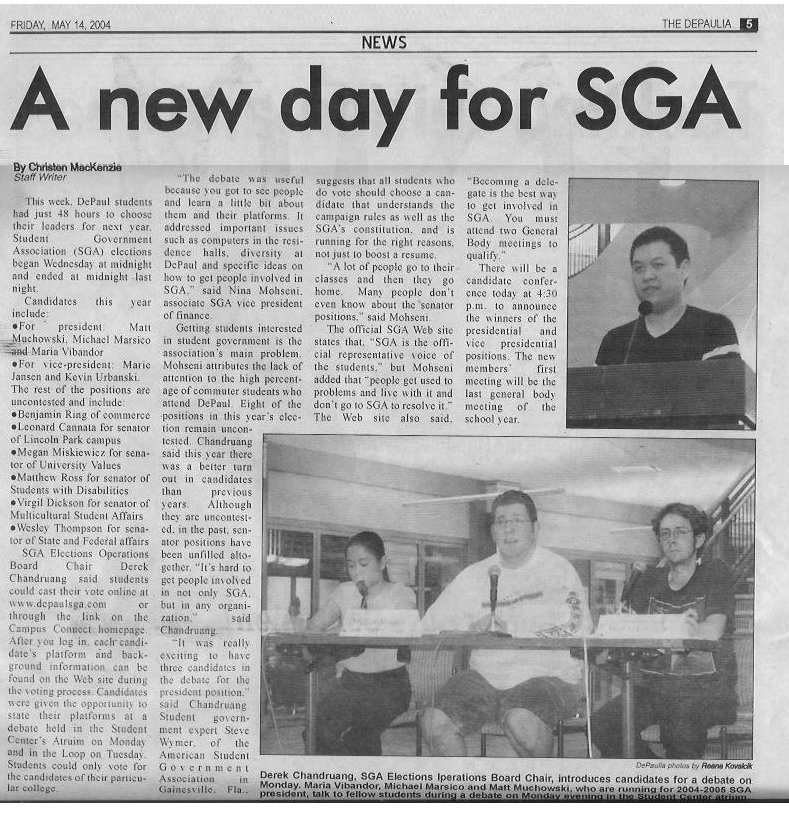
A New Day for SGA by Christen MacKenzie
These are from the May 14, 2004 issue of the DePaulia. The Article is by Christen MacKenzie and the Photos by Reana Kovalcik. The first photo was on the front cover.
I'm posting it since I was a candidate for President of Student Government and this documents the debate. I'm in the Smashing Pumpkins t-shirt.


I'm posting it since I was a candidate for President of Student Government and this documents the debate. I'm in the Smashing Pumpkins t-shirt.

Subscribe to:
Posts (Atom)